
E-E-A-T didn’t just survive the AI shift; it became more important.
There’s a concept in the apartment industry that’s been quietly running the show long before AI search arrived: reputation. Renters have always chosen communities based on whom they trust, whom they recognize, and whom others recommend. Turns out, AI engines work exactly the same way.
E-E-A-T, Google’s framework for evaluating Experience, Expertise, Authoritativeness, and Trustworthiness, used to feel like background noise. A quality guideline buried in Google’s Search Quality Rater documentation that most property marketers never needed to think about directly. But in 2026, E-E-A-T has quietly become the single most important factor determining whether AI engines cite your property, or your competitor’s.
What E-E-A-T Actually Means
Let’s break it down without the jargon:
Experience means you’ve actually done the thing. For a multifamily property, this looks like content written from real operational knowledge, move-in tips specific to your building, neighborhood guides based on what your leasing team actually tells new residents, and maintenance insights from your property managers. Not a generic filler anyone could write.
Expertise means you demonstrably know your subject. Your website should signal authority in your local market, community amenities explained in depth, local area knowledge, and pet policies that actually answer the questions renters are asking.
Authoritativeness means others recognize you. This is where third-party signals come in: reviews on Google and other platforms, mentions on local news sites, citations from community organizations, and partnerships with local businesses. Authority isn’t self-declared. It’s earned when other credible sources cite you.
Trustworthiness means your content is accurate, transparent, and verifiable. Pricing that’s current. Consistent contact information everywhere it appears. An SSL certificate. A privacy policy. No mystery about who owns and operates the property.
Why It Matters More Now, Not Less
Here’s what changed: AI engines have a sourcing problem. The internet is now flooded with low-effort, AI-generated content that reads well but says nothing. Every AI engine, ChatGPT, Perplexity, Google’s AI Overviews, has to decide which sources to trust when a renter asks, “What’s the best apartment near downtown with a dog park?”
E-E-A-T is how they decide.
When AI systems retrieve sources to build their answers, they tend to favor content that appears verifiably human, well-proven, and backed by real signals. Fluency isn’t enough. A page can be perfectly written and completely ignored if there’s no evidence to back it up.
The data makes this concrete: Semrush research found that Google AI Overviews show about 86% domain overlap with traditional organic search results, meaning ranking well organically still matters.
But it’s not the whole game.
What makes this worth paying attention to for your bottom line: Semrush’s AI search study found that the average AI search visitor converts at 4.4x the rate of a traditional organic visitor, because by the time they reach your site, they’ve already compared options and pre-qualified themselves through the AI summary. You’re not just earning visibility. You’re earning the right kind of visibility.
This is the shift. Brand authority now matters more than keyword rankings.
What This Looks Like for Multifamily Properties
The good news is that multifamily properties are actually well-positioned to win on E-E-A-T, if they’re intentional about it. You have something most content farms and generic listing aggregators will never have: real, local, specific, human knowledge.
The key is making that knowledge visible and verifiable.
Experience shows up when your content reflects real operational depth. A blog post titled “5 Things to Know Before Moving Into [Your City] in Winter,” written from your leasing team’s actual experience, is exactly the kind of content AI wants to cite. Generic “apartment hunting tips” written by no one in particular is not.
Expertise shows up in consistency. One blog post doesn’t build authority. A connected body of content, neighborhood guides, resident FAQs, local event roundups, maintenance how-tos, signals to AI engines that this property knows what it’s talking about across a topic, not just once.
Authoritativeness shows up in your review volume and quality, your presence on local directories, and whether your property gets mentioned anywhere beyond your own website. This is why reputation management isn’t a separate strategy from GEO; it is GEO.
Trustworthiness shows up in the details. Is your NAP (Name, Address, Phone) identical everywhere it appears online? Is your pricing current? Do you have a clear, easy-to-find privacy policy? These aren’t just compliance checkboxes; they’re signals AI engines use to decide if you’re a safe source to recommend.
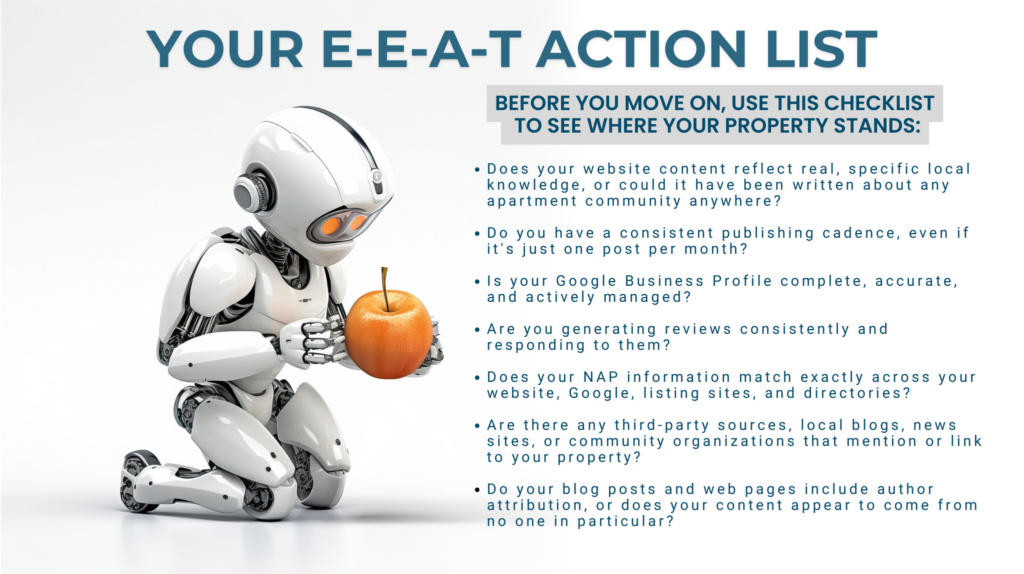
You don’t have to be everywhere. You don’t have to publish daily. But you do have to be real, consistent, and verifiable, because AI engines are now doing exactly what savvy renters have always done. They’re looking for the property that clearly knows what it’s doing and has the receipts to prove it.
That’s E-E-A-T. And yes, it’s very much still on the menu.
This is Part 5 of our Demystifying GEO series. Next up: Internal Linking, why the way your pages connect to each other matters more than you think.
About the Author: Christina Simms is a multifamily marketing and communications strategist who helps advise multifamily properties navigate the shift from traditional SEO to AI-powered search. Through her “Demystifying GEO” content series, she translates complex technical concepts into practical solutions enabling her multifamily clients to create more brand presence in an ever-increasing competitive landscape.

